


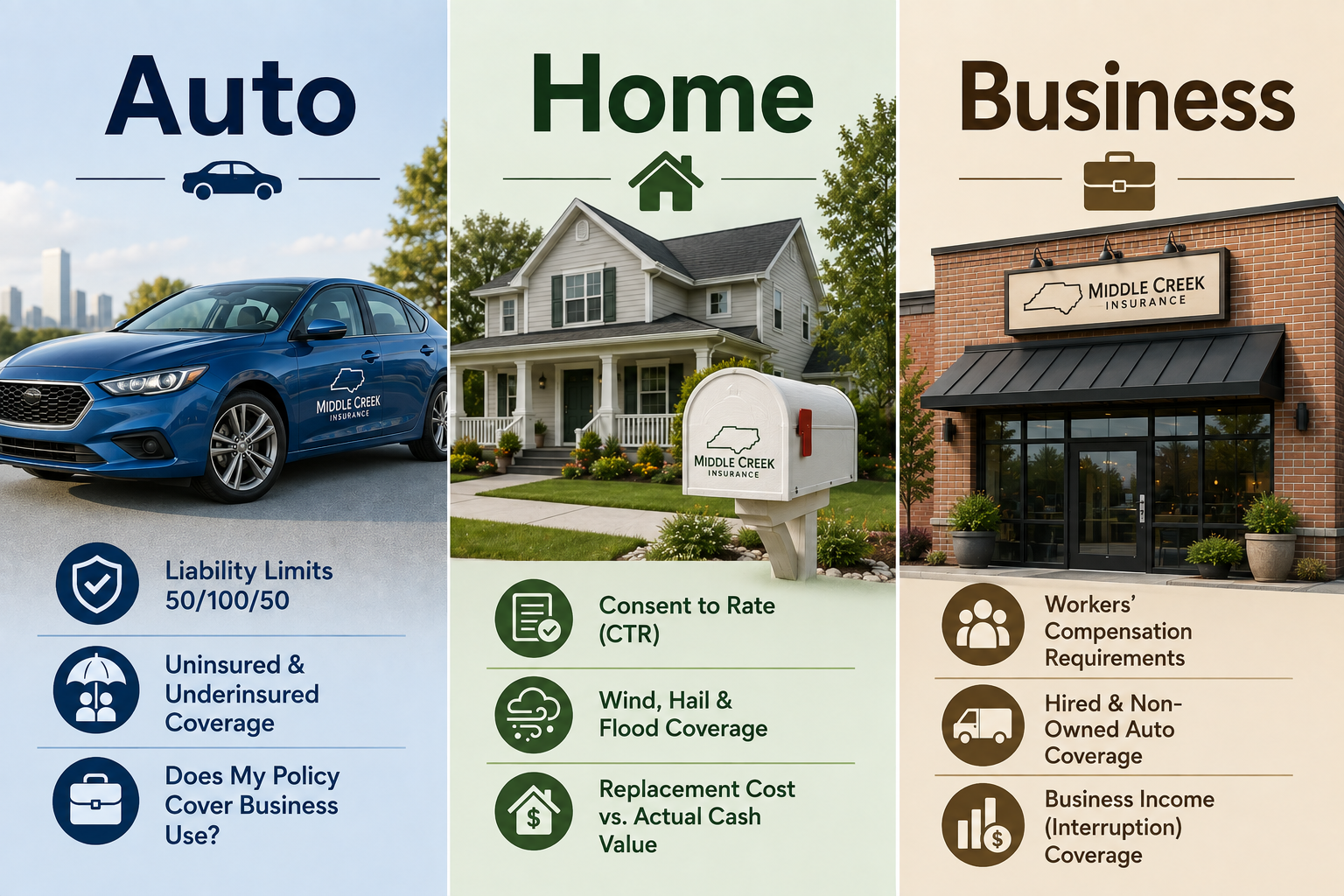
Insurance policies can be easy to renew year after year without taking a close look at what has changed.
But in North Carolina, homeowners, drivers, and business owners should understand a few state-specific insurance rules—as well as the limits, deductibles, exclusions, and endorsements contained in their individual policies.
Here are nine questions worth asking during your next insurance review, along with some general answers to help you know what to look for.
🏠 Homeowners Insurance Questions
1. What does “Consent to Rate” mean on a North Carolina homeowners policy?
North Carolina uses rates filed through the North Carolina Rate Bureau, but insurers may sometimes charge a rate above the applicable Rate Bureau rate through a process known as Consent to Rate, or CTR.
For residential property insurance, North Carolina law places a cap on how far above the applicable rate an insurer may go through CTR. The North Carolina Department of Insurance has stated that the residential property CTR cap is 250% above the otherwise applicable rate.
If a Consent to Rate applies to your policy, review the notice carefully so you understand the rate being charged.
A CTR does not automatically mean something is wrong with your policy, and the reason for a particular rate can vary based on underwriting and other factors.
Question to ask your agent:
“Is my homeowners premium using Consent to Rate, and if so, can you explain the rate shown on my policy?”
2. Does my homeowners policy include wind, hail, and flood coverage?
These are important coverages to separate because they are not necessarily handled the same way.
Flood: Standard homeowners insurance does not cover flood damage. Flood insurance is generally purchased separately, including through policies available through the National Flood Insurance Program or other available markets.
Wind and hail: Many North Carolina homeowners policies include wind and hail, but homeowners in certain areas—particularly coastal areas—may need separate windstorm and hail coverage.
The answer depends on the policy and property location, so don’t assume all three hazards are treated the same way.
Question to ask your agent:
“Can you show me how my policy addresses wind, hail, and flood, including any separate deductibles or exclusions?”
3. Is my property insured at Replacement Cost or Actual Cash Value?
This distinction can make a significant difference after a covered property loss.
Actual Cash Value (ACV) generally takes depreciation into account when determining the value of damaged property.
Replacement Cost Value (RCV) generally bases settlement on the cost to repair or replace covered property with similar property without deducting depreciation, subject to the policy’s provisions.
Even when replacement cost coverage applies, the claims process may initially involve an ACV payment, with recoverable depreciation paid after repair or replacement requirements are satisfied.
Also remember that the dwelling and your personal belongings may not necessarily have identical loss-settlement provisions.
Question to ask your agent:
“Are my dwelling, roof, and personal belongings settled at replacement cost or actual cash value, and what conditions apply?”
🚗 Auto Insurance Questions
4. What are North Carolina’s current minimum auto liability limits?
For North Carolina automobile policies issued or renewed on or after July 1, 2025, the minimum liability limits increased to:
- $50,000 bodily injury liability per person
- $100,000 bodily injury liability per accident
- $50,000 property damage liability per accident
This is commonly written as 50/100/50.
Those amounts are legal minimums—not a recommendation for every household.
Your appropriate liability limits depend on the coverage you request, your circumstances, and your budget.
Question to ask your agent:
“What liability limits are currently on my policy, and what higher-limit options are available?”
5. What Uninsured and Underinsured Motorist coverage do I have?
This area also changed in North Carolina.
Beginning July 1, 2025, Underinsured Motorist coverage is included on new or renewed North Carolina auto policies under the updated law.
In general:
Uninsured Motorist coverage may apply when an insured person is injured by a driver who does not have applicable liability insurance, subject to the policy and circumstances.
Underinsured Motorist coverage may apply when the at-fault driver’s available liability coverage is insufficient in relation to damages, again subject to applicable law and policy terms.
Rather than assuming your UM/UIM coverage is a particular amount, look at the declarations page of your auto policy.
Question to ask your agent:
“What UM and UIM limits are shown on my policy, and what options are available to me?”
6. Does my personal auto insurance cover business use of my vehicle?
The answer depends on how the vehicle is being used and the wording of the policy.
Occasionally driving to a meeting or performing certain work-related errands is not necessarily treated the same way as operating a vehicle for delivery, transporting passengers for a fee, or regularly using a vehicle as part of a business.
For example, the North Carolina Department of Insurance specifically notes that a personal automobile policy does not provide liability coverage while a vehicle is being used as a public livery or conveyance in circumstances such as certain Transportation Network Company activity.
Because business-use restrictions and exclusions vary, it is important to tell your agent how a vehicle is actually being used.
Question to ask your agent:
“I sometimes use my vehicle for work. Does my current policy address that use, or should I consider another insurance option?”
💼 Commercial & Business Insurance Questions
7. When is Workers’ Compensation insurance required in North Carolina?
In general, the North Carolina Workers’ Compensation Act requires businesses that regularly employ three or more employees to obtain Workers’ Compensation insurance or qualify as a self-insured employer.
However, there are exceptions and special rules for certain types of employers and workers.
Business structure can also affect how individuals such as owners, officers, members, and other workers are treated.
That makes employee count only the starting point of the conversation.
Question to ask:
“Based on my business structure and workforce, am I required to maintain Workers’ Compensation insurance?”
Business owners can also learn more about available commercial insurance options on Middle Creek Insurance’s Business Insurance page.
8. What is Hired and Non-Owned Auto coverage, and should my business consider it?
A business can have an auto exposure even if it does not own company vehicles.
For example, an employee might use a personal vehicle to:
- Visit a customer
- Pick up supplies
- Go to the bank
- Travel between job locations
- Perform another errand on behalf of the business
Commercial auto underwriting may consider a company’s use of vehicles it does not own.
Hired and Non-Owned Auto, often abbreviated HNOA, is a coverage worth discussing when employees or owners use rented, hired, or personally owned vehicles for business purposes.
Whether it is appropriate depends on how the business operates and the available policy options.
Question to ask your agent:
“Do employees or owners create a non-owned auto exposure for my business, and what insurance options are available?”
9. What does Business Income or Business Interruption insurance do?
Property damage can affect more than the physical building.
If a business has to suspend operations after damage caused by an insured peril, it may also experience lost income while certain expenses continue.
Business Income or Business Interruption coverage may help address qualifying financial losses when the conditions of the policy are met.
The important phrase is insured peril.
Business Income coverage does not mean every business shutdown or every loss of revenue will be covered. The cause of loss, waiting periods, coverage limits, policy language, and other conditions all matter.
Question to ask your agent:
“What Business Income coverage is included in my commercial policy, what causes of loss can trigger it, and what limits and waiting periods apply?”
Your Insurance Policy Deserves More Than an Automatic Renewal
Insurance can change as your home, vehicles, family, or business changes.
Instead of asking simply, “Do I have insurance?”, consider asking:
“What does my policy actually say?”
Look at your:
- Coverage limits
- Deductibles
- Loss-settlement provisions
- Endorsements
- Exclusions
- Vehicle usage
- Property values
- Business operations
Middle Creek Insurance is available to help you review your insurance at your request and discuss available options based on your expressed insurance requirements and budget.
Have a Question About Your North Carolina Insurance?
Middle Creek Insurance
📞 (919) 524-2149
📍 9704 Fayetteville Rd, Raleigh, NC 27603
🌐 middlecreekins.com
Coverage availability, eligibility, limits, exclusions, deductibles, and policy terms vary by insurer and individual circumstances. This article is for general educational purposes. Refer to your individual policy for its specific terms and conditions.